






Construction waste recycling and its meaning
Construction and decoration waste treatment is a way to reuse solid waste as renewable resources. It mainly refers to the entire process of collection, transportation, disposal or resource reuse of construction and decoration waste. Construction waste is a type of garbage, which mainly includes waste concrete blocks, asphalt concrete blocks, bricks and tiles, miscellaneous soil, mortar and concrete scattered during the construction process, broken brick slag, metal, wood, waste materials generated from decoration and decoration, and various packaging Materials, other wastes and other types of solid waste.
Industry policy
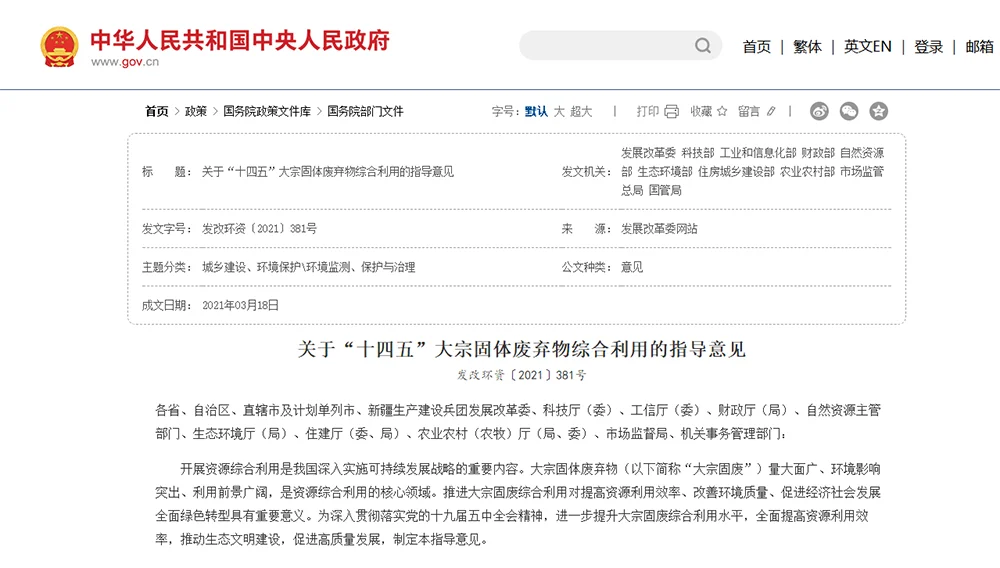
Since 2016, in order to promote the development of the construction and decoration waste treatment industry, the country has issued a series of relevant favorable policies. For example, in February 2016, the “Several Opinions on Further Strengthening Urban Planning and Construction Management” clearly stated for the first time that it would take about five years to basically establish a timetable for the recovery and recycling system of construction and decoration waste. In September 2020, the “Management Measures for the Announcement of Industry Standards for the Resource Utilization of Construction Waste (Revised Draft for Comments)” clarified the requirements for companies applying for announcements of the resource utilization of construction and decoration waste, and proposed to organize the promotion of advanced and applicable new energy-saving and emission-reduction technologies. , new processes and new equipment. In March 2021, the “Guiding Opinions on the Comprehensive Utilization of Bulk Solid Waste during the 14th Five-Year Plan” requires comprehensively improving resource utilization efficiency, promoting the construction of ecological civilization, and promoting high-quality development.
Construction market development
The construction industry is an important part of the national economy. In recent years, with the development of society and the continuous improvement of urbanization rate, my country’s construction industry has developed well. According to data, in the first half of 2021, my country’s construction industry achieved an increase of 3.33352 billion yuan, a year-on-year increase of 8.6%, accounting for 6.26% of the GDP.
With the continuous development of the construction industry, the total amount of construction and decoration waste emissions is also increasing. Up to now, the total annual discharge of construction and decoration waste has accounted for about 40% of urban waste, causing a serious ecological crisis. According to data, the total emissions of construction and decoration waste in my country in 2020 was 2.637 billion tons.
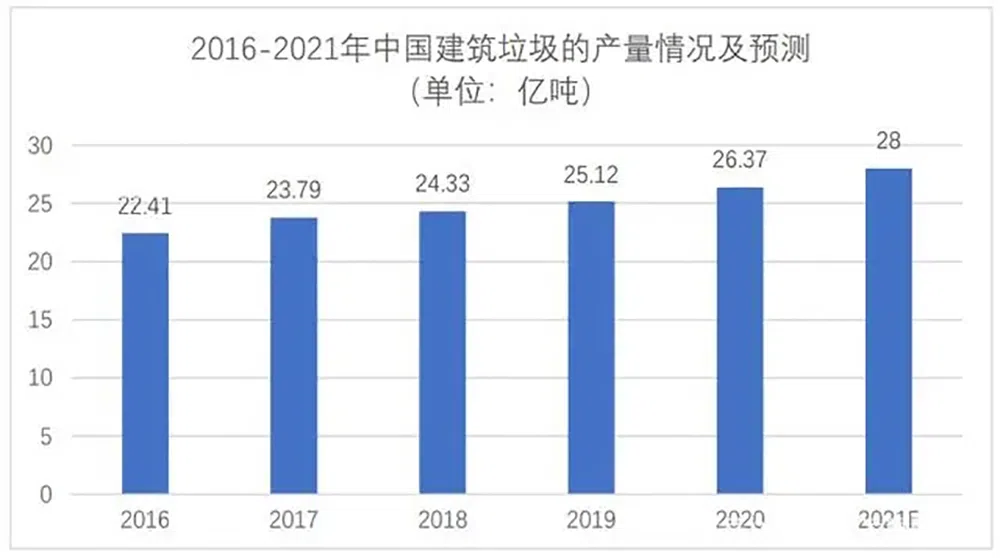
The amount of construction waste is increasing
Among the above-mentioned large amounts of construction and decoration waste, only 11,900 tons have been recycled domestically. At the same time, due to the lack of unified and complete construction waste management methods and the lack of scientific, effective and economically feasible disposal technology, the vast majority of construction and decoration waste has not been treated in any way, and most of the construction and decoration waste is transported to the outskirts of the city for open-air stacking or simple landfill. Current data shows that my country’s stock of construction and decoration waste has reached more than 20 billion tons.
At present, the main sources of construction and decoration waste in my country are generated from the demolition of old buildings, the construction of new buildings and building decoration. Among them, construction waste generated by the demolition of old buildings accounted for the largest proportion, reaching 58%; followed by construction waste generated by the construction of new buildings, accounting for 36%.
Although my country’s construction and decoration waste treatment market has developed rapidly in recent years, the resource utilization rate has continued to increase. However, compared with the resource utilization rate of more than 90% in countries such as Germany and South Korea, the resource utilization rate of construction and decoration waste in my country is still low, only 5%. It can be seen that there is still a lot of room for improvement in the recycling rate of construction and decoration waste in my country in the future. And if my country’s construction and decoration waste resource utilization can at least reach the level of Sread’s construction and decoration waste resource treatment system, the resource utilization of these construction wastes can create trillions of values.