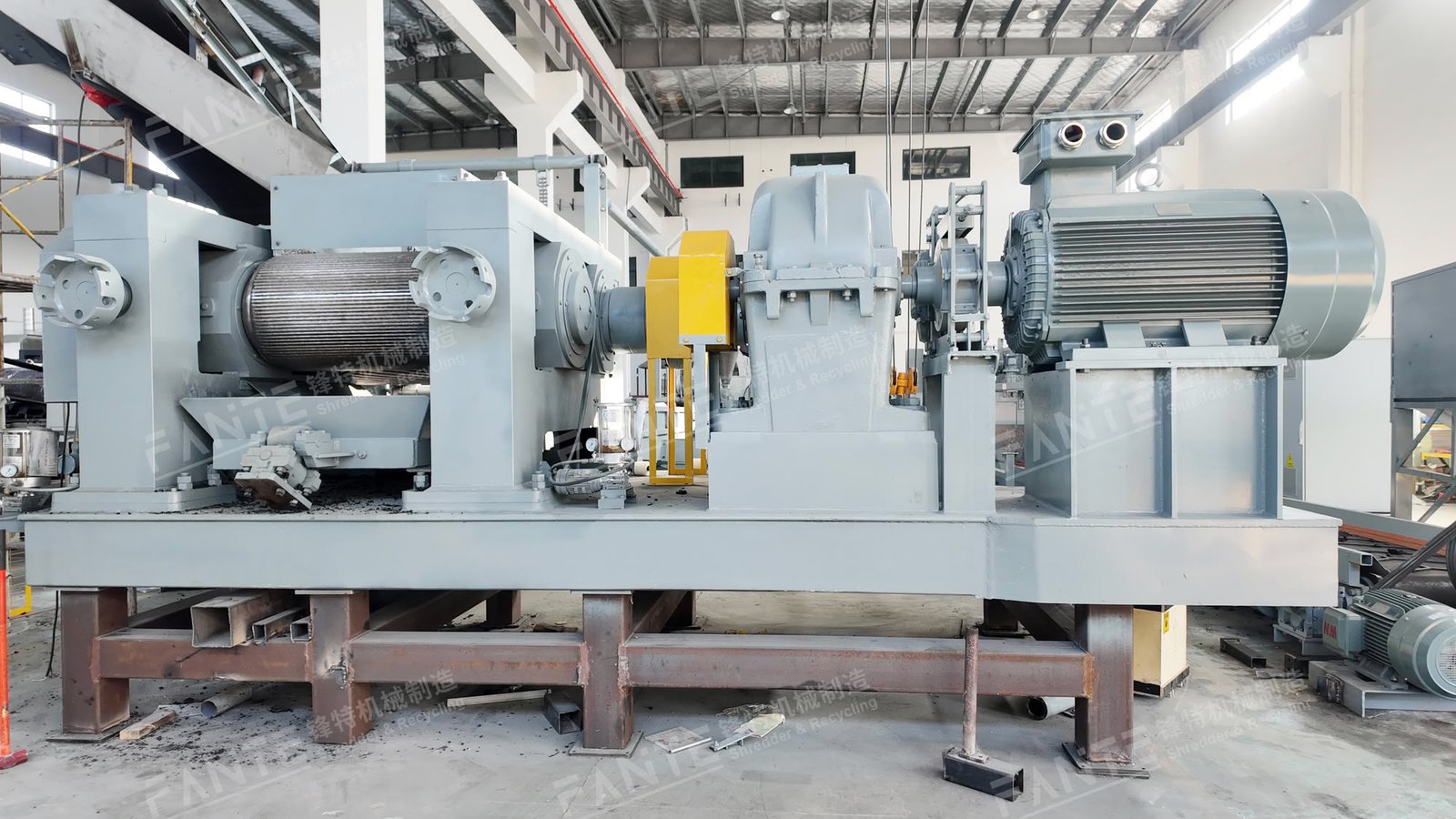
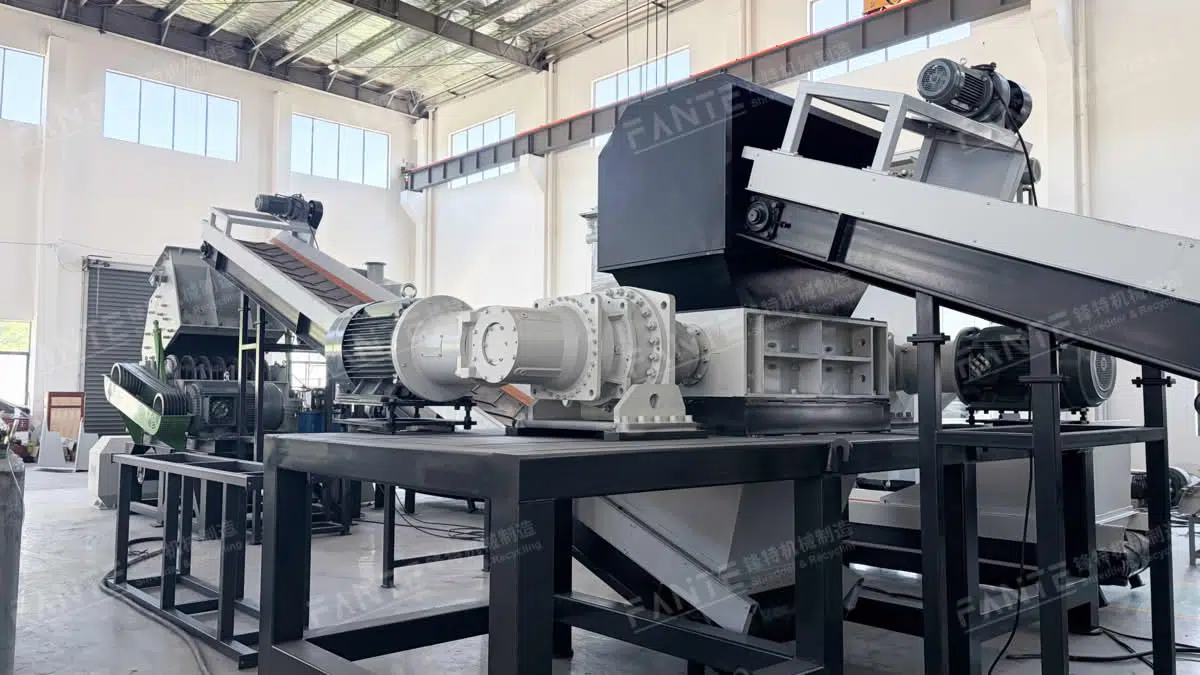
When planning a tire recycling plant, electricity consumption is an important part of operating costs. The total power demand depends on the equipment configuration, processing capacity, operating hours, and material conditions. Understanding how to estimate tire recycling line power consumption helps customers calculate electricity costs and evaluate project profitability.
1. What Determines the Power Consumption of a Tire Recycling Line?
A complete tire recycling line may include several types of equipment:
- Tire debeader or tire cutter
- Primary tire shredder
- Secondary shredder or rasper
- Rubber granulator
- Magnetic separator
- فاصل الألياف
- Vibrating screen
- Conveyor system
- Dust collection system
Each machine has a different motor rating and operating load.
The shredder and rasper usually account for a significant share of the installed power because they perform the main size-reduction work.
However, auxiliary equipment also consumes electricity. Conveyors, dust collectors, separators, and hydraulic systems should be included in the calculation.
2. How to Calculate the Total Installed Power?
The first step is to collect the rated power of every motor in the production line.
Use this formula:
Total Installed Power (kW) = Sum of All Equipment Motor Ratings (kW)
3. How to Estimate Actual Electricity Consumption?
Actual electricity consumption depends on the average operating load of the equipment.
Use the following formula:
Hourly Electricity Consumption (kWh) = Total Installed Power (kW) × Average Load Factor
For example:
- Total installed power: 300kW
- Assumed average load factor: 70%
Calculation:
300 × 70% = 210 kWh per hour
For an 8-hour operating shift:
210 × 8 = 1680 kWh per day
The 70% load factor is an illustrative assumption, not a guaranteed operating value. Actual consumption should be verified through electricity metering.
4. How to Calculate Electricity Cost?
Once hourly or daily electricity consumption is estimated, the operating electricity cost is straightforward to calculate.
Electricity Cost = Electricity Consumption (kWh) × Electricity Tariff ($/kWh)
For example, assuming:
- Daily consumption: 1680 kWh
- Electricity price: $0.12/kWh
Daily electricity cost:
1680 × $0.12 = $201.6 per day
Monthly electricity cost, assuming 20 operating days:
$201.6 × 20 = $4032 per month
The actual tariff varies by country, industrial electricity contract, and time of use. Demand charges and other utility fees may also apply.
5. How to Calculate Electricity Consumption per Ton?
For recycling plant owners, electricity consumption per ton is often more useful than total installed power.
It shows how much electricity is required to process one ton of waste tires.
Electricity Consumption per Ton (kWh/t) = Total Electricity Consumption (kWh) ÷ Actual Processed Material (t)
For example:
- Daily electricity consumption: 1680 kWh
- Actual daily throughput: 10 tons
Calculation:
1680 ÷ 10 = 168 kWh per ton
This is an estimated figure based on the assumed load factor and production volume.
For accurate comparisons, measure electricity consumption and actual processed tonnage over the same operating period.
6. What Factors Can Increase Electricity Consumption?
Several operating conditions can affect the actual energy demand.
1. Tire Type
Truck tires and OTR tires have thicker rubber sections and stronger steel reinforcement. They may require greater cutting force than passenger tires.
2. Output Size
Smaller output sizes generally require additional processing. More cutting, grinding, and screening can increase energy consumption.
3. Equipment Configuration
Different shredder structures, motor ratings, and transmission systems have different power requirements.
4. Feeding Conditions
Unstable feeding, frequent machine reversals, and material blockages can reduce production efficiency.
5. Equipment Maintenance
Worn cutting blades and poorly maintained components can increase mechanical resistance and reduce processing efficiency.
7. How Can a Tire Recycling Plant Reduce Electricity Costs?
Several practical measures can help control energy consumption:
- Match equipment capacity to the actual production target.
- Avoid unnecessary repeated shredding and material circulation.
- Maintain sharp cutting blades and proper machine clearances.
- Keep feeding systems stable and continuous.
- Use suitable motors and transmission systems.
- Monitor electricity consumption during normal production.
A well-matched production line can reduce unnecessary energy use while maintaining the required output size and processing capacity.
الخاتمة
Estimating tire recycling line electricity consumption requires more than adding motor ratings. Customers should consider installed power, actual operating load, working hours, and daily production.
The most useful indicators are total installed power (kW), hourly electricity consumption (kWh), electricity cost per day, and energy consumption per ton (kWh/t).
Before purchasing a recycling line, request a detailed motor power list and an estimated operating load. Actual electricity consumption should be confirmed through production testing under the specified tire type and output conditions.
الأسئلة المتداولة
No. Installed power is the combined rated motor capacity. Actual electricity consumption depends on operating load, machine running time, and production conditions.
Multiply the measured electricity consumption per ton (kWh/t) by the local electricity tariff ($/kWh).
Not necessarily. A larger line generally has higher installed power, but its electricity consumption per ton may be lower if it operates efficiently at a suitable production load.